


Author:
David Lucas
Partner
Bright Grahame Murray
Emperor’s Gate 114a Cromwell Road
Kensington, London, SW7 4AG
T: +44 (0)20 7402 7444 | F: +44 (0)20 7402 8444
E: [email protected]
W: www.bgm.co.uk
Edited by:
Integra International
Grant Gilmour, B.Sc., MBA, CA, CPA Canada, BC, CPA USA, Az, GDipICL.Sc.
INTEGRA TAX WORLD NEWSLETTER EDITOR
E: [email protected]
UK Tax Incentives for R&D, Innovation and Growth
The UK continues to position itself as an attractive jurisdiction for business and innovation, supported by a range of targeted tax incentives. These incentives sit alongside a main corporation tax rate of 25% (the lowest in the G7), as well as increased regulation and scrutiny driven by global alignment with OECD standards.
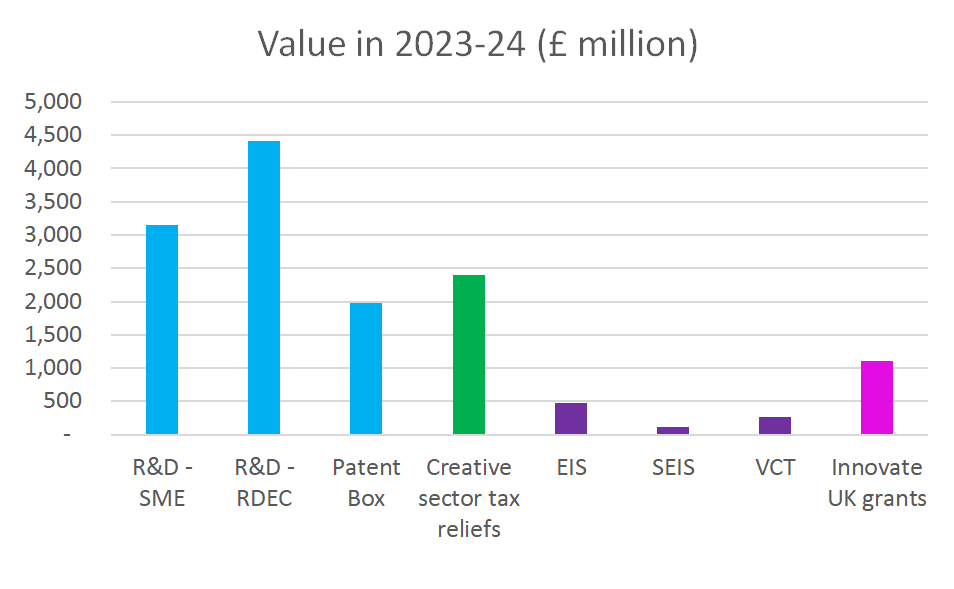
Approximately £12.8bn tax relief was given by UK government in 2023-24 (per the latest 2025 HMRC report) across innovation reliefs, creative sector reliefs and investment incentives. From this graph, it can be seen that Research and Development (R&D) tax relief represents the most significant area of tax support provided by the UK government for innovation.
Overall, the UK offers a broad range of reliefs aimed at supporting businesses to invest and grow, although accessing these reliefs required careful consideration and documentation.
Innovation Incentives
Research and Development (R&D) Regime
The UK provides tax relief for companies who are undertaking innovative projects in science and technology which seek to resolve scientific or technological uncertainty.
Relief is available on certain expenditure including:
- Staffing costs
- Externally Provided Workers (EPWs)
- Software and consumable items
- Data licences and cloud computing costs
- Relevant payments to the subject of clinical trials
- Certain subcontracted R&D costs (subject to restrictions)
For subcontracted and EPW costs, these have to be incurred in the UK unless in very rare circumstances it is not possible to undertake these activities in the UK. The cost or availability of workforce cannot be used as a reason for allowing non-UK costs.
From 1 April 2024, a merged scheme broadly based on the previous Research and Development Expenditure Credit (RDEC) regime applies to both large companies and small and medium-sized enterprises (SMEs). Previously SMEs and large companies had separate R&D regimes.
This regime provides a 20% taxable credit on qualifying expenditure and delivers a 15% benefit after tax (of 25%) for profit making companies. For loss making companies a repayable tax credit of 16.2% arises.
A key practical point is that a claim notification must be submitted to HMRC within six months of the end of the accounting period for first time claimants, or where there has been a gap between claims. In practice, this means that companies and advisors should identify potential R&D activity early, to ensure that claims are not time barred.
The amount of relief available is subject to a cap of £20,000 plus 300% of the company’s relevant Pay As You Earn (PAYE) and National Insurance Contributions (NIC) liabilities for employees, directors and certain externally provided workers.
There are exceptions to this cap where the company creates or actively manages intellectual property (IP).
The R&D claim numbers are included in the corporation tax return (which has a 12 month deadline from the year-end, but subject to the earlier 6 month claim notification deadline to proceed). An Additional Information Form (AIF) is also required to be filed separately with HMRC before the tax return is submitted with the full detail of the claim (numbers and narrative).
ERIS – Enhanced R&D Intensive Support for Loss Making SMEs
More generous reliefs are available for R&D intensive loss making SMEs, aimed at early stage businesses. This applies where more than 30% of the total relevant expenditure incurred is on R&D activity.
Relief is provided by an enhanced deduction of 86% of the relevant expenditure, with the resulting losses to be surrendered for a 14.5% payable tax credit. This is a net benefit of almost 27%.
This relief is a targeted approach by the UK government to support companies where innovation forms a core part of their business model, particularly start-up companies. This 30% test is applied at group level, meaning many groups will not meet the threshold.
HMRC Approach
From the 2025 HMRC R&D report,
“46,950 claims were made and £7.6bn of tax relief was awarded to UK companies for R&D expenditure.”
Due to the prevalence of fraudulent claims, HMRC took a volume based approach to enquiries in higher risk sectors from 2022 onwards with one in five claims having an enquiry. This has driven a decrease in the number of smaller claims.
HMRC’s approach is now evolving with work allocated to individuals in specialist teams with the focus shifting to fewer, more targeted enquiries.
The focus of claims is on showing that there is a clear advancement in science or technology to the industry as a whole and not just the company. Detailed records and evidence need to be kept as more attention is also being given to understand cost apportionments and methodologies.
A key factor is a ‘competent professional’, an expert with sufficient knowledge of the field to assess the technological uncertainty and existing technology in a field, and can confirm the R&D work is an advance from the initial position. For claims in the computer software industry which are common now with emergence of artificial intelligence (AI), this requires a computer software expert.
Patent Box Regime – Reliefs for Intellectual Property
The Patent Box Regime complements the R&D regime, by encouraging companies to develop and retain intellectual property within the UK.
This regime applies a 10% effective tax rate to qualifying patent profits. The amount of relief available is dependent on the amount of R&D which is undertaken in the UK and uses a Nexus fraction to calculate this.
Both reliefs can be used by UK standalone companies or UK members of groups, and is a planning consideration for tax and commercial purposes.
Investments in Assets and Infrastructure
Capital Allowances
The UK provides generous relief for capital investment by UK companies, particularly for capital-intensive and manufacturing businesses. These reliefs accelerate tax deductions which can improve cash flow.
Key reliefs include:
- Annual Investment Allowance (AIA) of 100% relief up to £1m per year
- Full expensing: 100% deduction for new and unused main-rate plant and machinery; 50% for special-rate assets
- A new 40% First Year Allowance (FYA) from 1 January 2026
- Writing down allowances of 14%/6%
- Structures and Buildings Allowance (SBA) of 3% per annum
Creative Sector Tax Reliefs
Some of the available reliefs include:
- Video Game Expenditure Credit (VGEC) – 34% taxable credit
- Audio Visual Expenditure Credit (AVEC) – 34–53% taxable credits
- Theatre, orchestra and museum tax reliefs – typically 45–50% relief
Employee Incentives
UK resident individual investors can access income tax and capital gains tax reliefs through:
- Enterprise Investment Scheme (EIS)
- Seed Enterprise Investment Scheme (SEIS)
- Venture Capital Trust (VCT)
Share schemes such as Enterprise Management Incentive (EMI) or Company Share Option Plan (CSOP) allow businesses to incentivise and retain employees.
Innovate UK Grants and Freeports
Innovate UK provides grants to UK SMEs to accelerate business innovation in priority sectors under the UK’s Industrial Strategy.
There are a number of Freeports across the UK, providing tax and customs benefits for companies and supporting regional development.
Conclusions
The UK has a broad offering of tax reliefs and incentives to encourage businesses to start, innovate and grow, as well as incentives for investors and employees.
At the same time, an increase in scrutiny and compliance requirements means that these reliefs need to be approached and documented carefully.
Overall the UK remains a competitive jurisdiction, particularly for innovation.
Disclaimer
This communication contains general information only based on collective research. Before making any decision or taking any action that may affect your finances or your business, you should consult a qualified professional adviser. No representations, warranties or undertakings (express or implied) are given as to the accuracy or completeness of the information in this communication, and none of Bright Grahame Murray Chartered Accountants, Integra International, related entities, employees or agents shall be liable or responsible for any loss or damage whatsoever arising directly or indirectly in connection with any person relying on this communication.
Bright Grahame Murray Chartered Accountants and Integra International, and their related entities, are legally separate and independent entities.
© 2026 Integra and Bright Grahame Murray Chartered Accountants
About the Author:

David Lucas
Partner
David is a Corporate Tax Partner at Bright Grahame Murray. He works with an extensive portfolio of clients, particularly large international groups, across a broad range of sectors including real estate, insurance and transport.
He has particular experience at providing advice in relation to the corporate interest restriction, group and consortium relief, capital allowances and financing transactions.
David qualified as a Chartered Tax Adviser while working for a top 25 accountancy Firm and joined Bright Grahame Murray in 2021.
Away from work, David enjoys following most mainstream sports, playing football, cycling and spending time with his family.
About Bright Grahame Murray:
Our aim is to help clients make the most of the opportunities available to them.
This philosophy has formed the basis of all our services since 1934 when the practice was formed. Today, the comprehensive range of services we provide is underpinned by a partner led service and a reputation for excellence.
We believe in working with our clients in a structured yet flexible way. Each client is assigned to a Client Service Partner who is responsible for co-ordinating all the services we offer.
This partner will work with you to discover your objectives and priorities and draw together the specialist skills and expertise of the most appropriate partners and staff to help you achieve your goals.
The Client Service Partner will monitor the services you receive to ensure that the input from the firm’s specialists is efficiently and effectively integrated. Most importantly, the Client Service Partner will keep in close contact with you throughout the year so as to maintain an overall perspective on your affairs ensuring that you get the best from us now, and as your business grows, in the future.
Bright Grahame Murray is registered to carry out audit work in the UK and regulated for a range of investment business activities by The Institute of Chartered Accountants in England & Wales.
Firm Profile:
https://integra-international.net/find-an-integra-firm/find-firm-profile/name/bright-grahame-murray/
Bright Grahame Murray Website:
https://www.bgm.co.uk/
