


Authors:
David Bottemer
DPA Expertise Conseil, SARL / Partner
E: [email protected]
LinkedIn: linkedin.com/in/david-bottemer-b29721254
Lise Daudier de Cassini
Batt & Associés / Partner
E: [email protected]
LinkedIn: linkedin.com/in/lise-daudier-de-cassini
Edited by:
Integra International
Grant Gilmour, B.Sc., MBA, CA, CPA Canada, BC, CPA USA, Az, GDipICL.Sc.
INTEGRA TAX WORLD NEWSLETTER EDITOR
E: [email protected]
E-invoicing in France in 2026
France is implementing mandatory B2B e‑invoicing and e‑reporting in phases, supported by a national infrastructure originally developed for public‑sector invoicing. The system is transitioning from a centralized model to a decentralized network of certified platforms. The framework is designed to support tax compliance, improve data quality, and facilitate real‑time reporting.
E-Invoicing in France: Current Framework and Implementation
France is progressing toward mandatory electronic invoicing and electronic reporting for business‑to‑business (B2B) transactions. The framework builds on the existing public‑sector e‑invoicing system and introduces new requirements for structured invoice formats, certified platforms, and real‑time data transmission.
Implementation Timeline
France is introducing mandatory B2B e‑invoicing and e‑reporting in phases. The timeline has been adjusted several times, but the overall structure includes:
- A phased rollout based on business size
- Mandatory receipt of e‑invoices
- Gradual expansion of reporting obligations
The implementation schedule is designed to allow businesses and service providers to adapt to the new requirements.

E-Invoicing in Local Law
- French General Tax code (CGI)
– Article 289-0 – Article 289 and Article 289 bis
– Article 242 nonies A and B (Appendix II of the CGI)
- Finance Law N°2023-1322 – of December 29, 2023
– Article 91
- Decree N°2024-266 of March 25, 2024
– Amending Decree n°2022-1299 of October 7, 2022
Decentralized Exchange Model
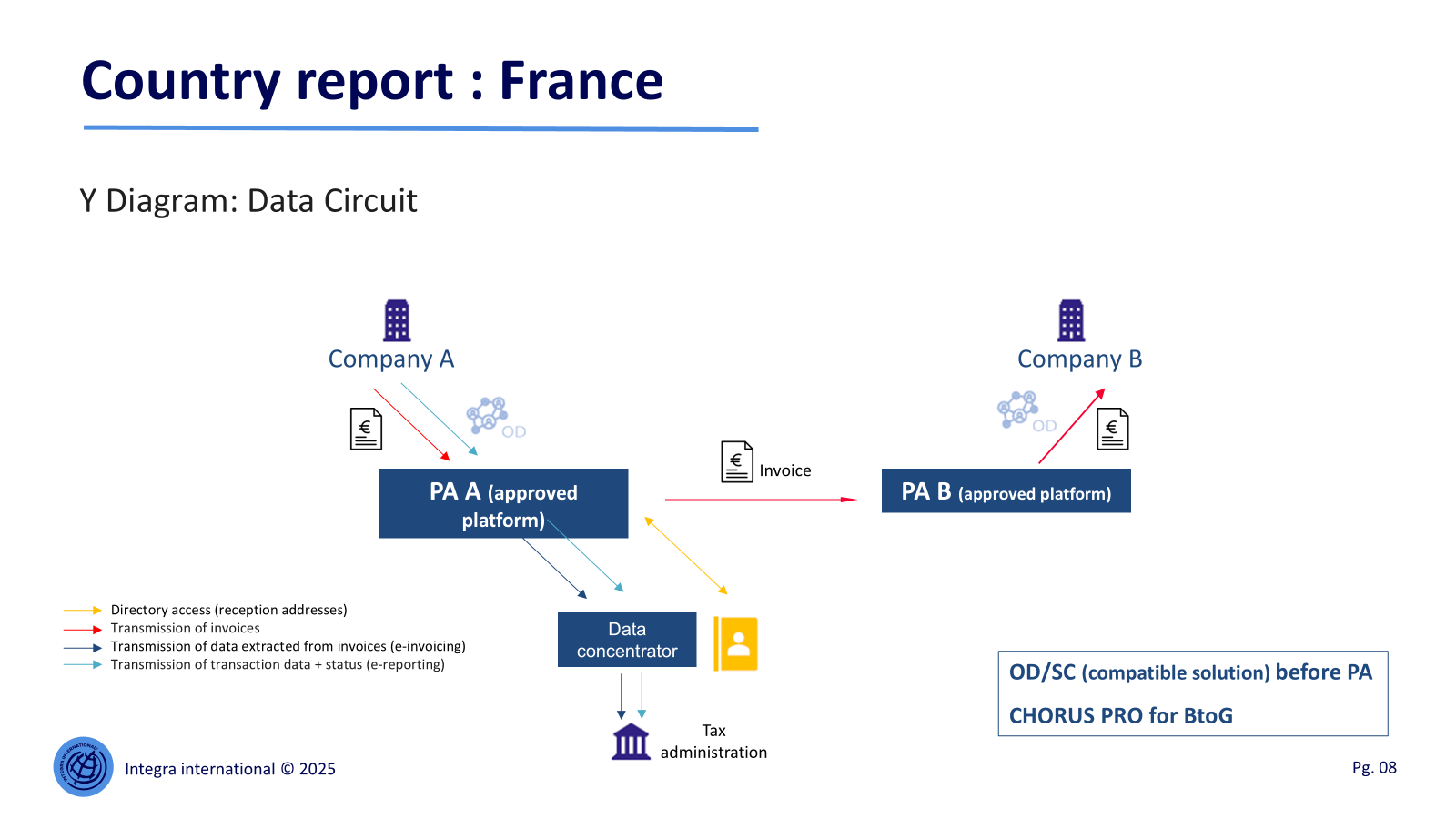
France is transitioning from a centralized system to a decentralized network of:
- Approved Platforms PA – Plateforme Agréée, which are certified private platforms
- These then interface with the Public Invoicing Portal (PPF) – operated by the government which is a data concentrator.
- CHORUS PRO is the approved platform for Business to Government transactions.
Under this model:
- Businesses may use a certified PA
- PAs exchange structured invoices directly with each other
- The PPF acts as a fallback and central directory
This structure is intended to support interoperability and ensure secure data transmission.
Starting in September 2026, companies supplying the public sector will have the choice of submitting their invoices:
- Either by using an approved platform (except for the management of the public sector’s legal commitments repository, which are specific to Chorus Pro=.
- Or by using Chorus Pro and its methods for sending invoices to government agencies (State, local authorities, public institutions, national public interest groups (GIPs), or any public body)
IT Solutions
More than 130 platforms are approved and there should be some more in the future. Accounting software publishers are among them. We are awaiting the final list approved by our Department of Finance. The Association of Chartered Accountants in France has also the approval for its own tool.

E-invoicing and tax audits
- We don’t have experience with tax audits yet but:
- The tax administration set up special brigades to audit software in 2014. The reform is going to improve their capacities
- Today, every Monday, the tax administration gets a lot information from 700 robots; they benefit from a lot of information.
- They need to improve their ability to analyze all the information. It will be done.
- It’s going to facilitate their audits on cross-border transactions
Influence of e-invoicing to the accounting profession
A lot of work for the next six months. We need to:
- Choose the platform for our firms
- Be sure we work with the right software and the right platform; we must do tests.
- Train our employees.
- Map the clients
- Analyze the incoming and the outgoing flows
- We have a mandate to help clients to choose the right platform suited to their organization
- A lot of work to accompany our clients
Cross border transactions
Transactions between a VAT-registered entity established in France and a non-registered entity
- Invoice in a free format
- Transmission of invoices and receipts according to a free process
- Transmission to the DGFIP (French Directorate General of Public Finances – Tax administration) of transaction data aggregated by day (B2C) or by invoice (B2B) and payment data for services that have not opted for VAT on debits.
- Flow frequency: ten-day / monthly / bi-monthly
French government has recently (July 25, 2025) joined Peppol network, which could enable interoperability for cross-border transactions in the future.
Conclusion
France’s e‑invoicing and e‑reporting framework represents a significant modernization of its tax and invoicing systems. The transition to a decentralized exchange model, combined with structured formats and real‑time reporting, positions France as one of the leading jurisdictions in the EU’s digital invoicing landscape.
Disclaimer
This communication contains general information only based on collective research. Before making any decision or taking any action that may affect your finances or your business, you should consult a qualified professional adviser. No representations, warranties or undertakings (express or implied) are given as to the accuracy or completeness of the information in this communication, and none of DPA Expertise Conseil, Batt & Associés, Integra International, related entities, employees or agents shall be liable or responsible for any loss or damage whatsoever arising directly or indirectly in connection with any person relying on this communication.
DPA Expertise Conseil, Batt & Associés, and Integra International, and their related entities, are legally separate and independent entities.
© 2026 Integra and DPA Expertise Conseil and Batt & Associés
About the Authors:

David Bottemer
Certified Auditor, partner at DPA Expertise Conseil
About DPA Expertise Conseil:
DPA Expertise Conseil is a consulting and accounting firm located in the Gers area in Gascony, in the South-West of France. Founded in Nogaro, the consulting firm has expanded and has now three more offices: in Gimont, Samatan and in Toulouse suburbs (Plaisance du Touch).
Integra International Bio:
DPA Expertise Conseil:
https://www.dpaec.fr/dpa-expertise-conseil-en

Lise Daudier de Cassini
CPA/Chartered Accountant Auditor CPA/Chartered Accountant (Luxembourg) Approved Statutory Auditor (Luxembourg
Lise joined Batt & Associés in 1997. She assists sole proprietorship businesses and corporations in the industrial and services sectors, as well as non-profit organizations. She guides corporate groups and their subsidiaries abroad. She operates at the Neufchâteau and Nancy offices of Batt & Associés.
About BATT & ASSOCIES:
BATT & ASSOCIES is an accounting, auditing and advisory firm created in 1971. They assist more than 5 500 clients located in Grand Est, Paris and Grenoble area and offer high quality and tailor-made services with their teams who are proactive and client-centered.
Integra International Bio:
https://integra-international.net/find-an-integra-firm/find-firm-profile/name/batt-associes/
Batt and Associés:
